Pool Construction Timeline
By HomePros Editorial Team
Direct answer
Pool Construction Timeline
A comprehensive guide to pool construction timeline for your pool and spa building project. Learn about costs, materials, installation processes, and best practices. Use this guide for materials, cost drivers, process, and questions to ask before you hire — then request a free estimate when ready.

Pool Construction Timeline
Pool and spa construction and renovation occupy a specialized niche within residential construction — one where structural engineering, plumbing, electrical work, and chemistry all converge in a single project. A pool must be engineered to resist not only the weight of the water it contains (approximately 8.34 pounds per gallon, meaning a typical 20,000-gallon pool imposes about 167,000 pounds of load) but also the hydrostatic pressure from groundwater in the surrounding soil, which can exert upward force that damages or even floats an empty pool shell. Understanding Pool Construction Timeline means appreciating how each of these forces influences design and material choices.
The swimming pool industry has evolved substantially over the past two decades. Variable-speed pumps now reduce energy consumption by 50 to 80 percent compared to single-speed models, paying for their higher purchase price within 1 to 2 years of operation. Salt chlorine generators have moved from a luxury upgrade to a standard feature on the majority of new residential pools. Automation systems that control pumps, heaters, lights, valves, and chemical dosing from a smartphone app have similarly transitioned from exotic to expected. Understanding these technologies and how they fit into your specific project is essential for making decisions that produce a pool that is enjoyable to own — not one that becomes a source of frustration due to high operating costs, constant maintenance requirements, or equipment that is undersized or mismatched to the pool's demands.
Site Preparation and Excavation
Site work for pool and spa building construction involves far more than simply digging a hole. A geotechnical survey should evaluate soil composition, bearing capacity, and groundwater conditions before design is finalized. Expansive clay soils that swell when wet and shrink when dry — common across much of the southern and western United States — require over-excavation (removing 2 to 4 feet of expansive soil and replacing it with compacted select fill) or engineered structural slabs to prevent the pool shell from being subjected to soil movement forces that can crack concrete and shear plumbing. High water tables require dewatering systems — well points and pumps — during construction and may necessitate hydrostatic relief valves in the pool floor to prevent groundwater pressure from lifting the empty shell.
Access for excavation equipment is a practical consideration that significantly affects cost. A standard track excavator requires approximately 8 feet of width clearance and can traverse moderate slopes, but steep terrain, narrow side yards, overhead utility lines, or septic system locations can require smaller equipment with lower production rates — or in extreme cases, hand excavation. Excavated soil volume typically exceeds the pool hole volume by 20 to 35 percent due to the expansion that occurs when compacted soil is loosened, and this excess material must be removed from the site unless it can be used elsewhere on the property for grading or landscaping features. Soil removal costs $200 to $800 per truckload depending on local disposal fees, and a standard 600-square-foot pool generates 8 to 15 truckloads of excess soil — a cost often omitted from initial estimates. Rock excavation, if encountered, can add $5,000 to $20,000 or more depending on rock type and volume. A pre-excavation site assessment that includes probing for rock and a realistic evaluation of access conditions prevents surprises that can derail budgets.
Pro Fact
A well-designed in-ground pool adds 5-7% to home value on average, with the highest returns in warm climates — but the primary value is lifestyle enhancement; pools rank as the #1 'joy score' home improvement at 10/10.
Source: NAHB / PHTA 2025 Pool Market Report
Water Chemistry and Sanitation Systems
Maintaining safe, comfortable, and clear pool water requires managing multiple chemical parameters that interact with each other — changing one parameter often affects others. Free chlorine levels should be maintained at 1 to 3 parts per million for residential pools, with cyanuric acid (stabilizer) at 30 to 50 PPM to protect chlorine from UV degradation in outdoor pools. The relationship between these two is important: cyanuric acid slows chlorine's sanitizing action, and at levels above 100 PPM — a common problem in pools that use stabilized chlorine products exclusively — chlorine becomes significantly less effective, potentially allowing algae and bacterial growth even when test strips show adequate chlorine levels. The only practical solution for high cyanuric acid is partial water replacement.
pH should be maintained between 7.2 and 7.6, with the lower end of this range providing more effective chlorine sanitation and the higher end being more comfortable for swimmers' eyes and skin. Total alkalinity — the water's buffering capacity — should be 80 to 120 PPM, as alkalinity below this range allows pH to fluctuate rapidly while alkalinity above this range makes it difficult to adjust pH. Calcium hardness should be 200 to 400 PPM; low calcium hardness causes the water to become aggressive, leaching calcium from plaster and grout, while high calcium hardness causes scaling — white calcium carbonate deposits on pool surfaces, inside plumbing, and on equipment.
Salt chlorine generators have become the dominant sanitation method for new residential pool construction, representing approximately 65 to 75 percent of new installations. These systems use electrolysis to convert dissolved salt (typically 2,700 to 3,400 PPM — roughly one-tenth the salinity of seawater) into chlorine, eliminating the need to handle and store chlorine products. The initial cost of $1,200 to $2,500 for equipment and installation is offset by eliminating ongoing chlorine purchases, typically saving $300 to $600 annually. The salt cell requires replacement every 3 to 7 years at a cost of $500 to $900, and salt water is corrosive to certain metals — pool ladders, light fixtures, and heater heat exchangers must be specified for salt water use. Alternative sanitation systems include ozone generators, which inject ozone gas into the circulation system as a powerful oxidizer that reduces chlorine demand by 50 to 80 percent, and ultraviolet systems that use UV-C light to destroy pathogens and break down chloramines — the compounds responsible for the "chlorine smell" and eye irritation associated with pools. Both ozone and UV are supplemental systems that reduce but do not eliminate the need for a chlorine or bromine residual in the water.
What's the most popular pool type in the US?
Pool Types: Construction Methods and Characteristics
Three primary construction methods dominate the residential pool market, each with distinct characteristics. Gunite or shotcrete pools — pneumatically applied concrete sprayed over a steel rebar framework — represent the premium end of the market. They offer complete design flexibility in shape, size, and depth; can incorporate complex features like vanishing edges, beach entries, and integrated spas; and have an expected structural lifespan of 50-plus years. The construction process takes 8 to 12 weeks for a standard pool, with costs typically ranging from $50,000 to $100,000 for a basic installation and $100,000 to $300,000 or more for high-end projects with features. The interior finish — plaster, pebble, quartz, or glass bead — requires replacement every 10 to 20 years at a cost of $5,000 to $15,000 for a standard-sized pool, making this a significant lifecycle cost consideration.
Fiberglass pools are manufactured as single-piece shells in a factory and delivered to the site for installation in an excavated hole. Installation is significantly faster — typically 2 to 4 weeks from excavation to swimming — and the gel coat interior finish resists algae growth and staining better than plaster and never requires replacement. Fiberglass pools cost $30,000 to $60,000 for the pool itself including installation, with additional costs for decking, fencing, and landscaping. The primary limitation is size and shape: fiberglass shells are limited to approximately 16 feet in width to accommodate highway transport, and the available shapes are determined by manufacturer molds rather than custom design. In regions with high water tables or expansive soils, engineering requirements for fiberglass pool installation can add significant cost due to the need for gravel backfill, dewatering systems, or concrete collars to prevent shell movement.
Vinyl liner pools use a flexible PVC liner stretched over a wall panel structure — typically steel, aluminum, or polymer — with a sand or vermiculite floor. They offer the lowest initial cost at $25,000 to $45,000 for a standard installation and allow customization of shape. Liner replacement is required every 8 to 15 years at a cost of $3,000 to $6,000, and liners are susceptible to punctures from sharp objects, pet claws, and pool cleaning equipment that catches edges. Polymer wall panels provide superior corrosion resistance compared to steel in areas with aggressive soil chemistry or high groundwater, though at a higher material cost. Vinyl liner pools make up approximately 35 to 40 percent of the in-ground residential pool market in the United States, with higher market share in the Northeast and Midwest where lower construction costs and shorter swimming seasons favor their lower initial investment.
What's your ideal pool design?
Deck, Coping, and Surrounding Hardscape
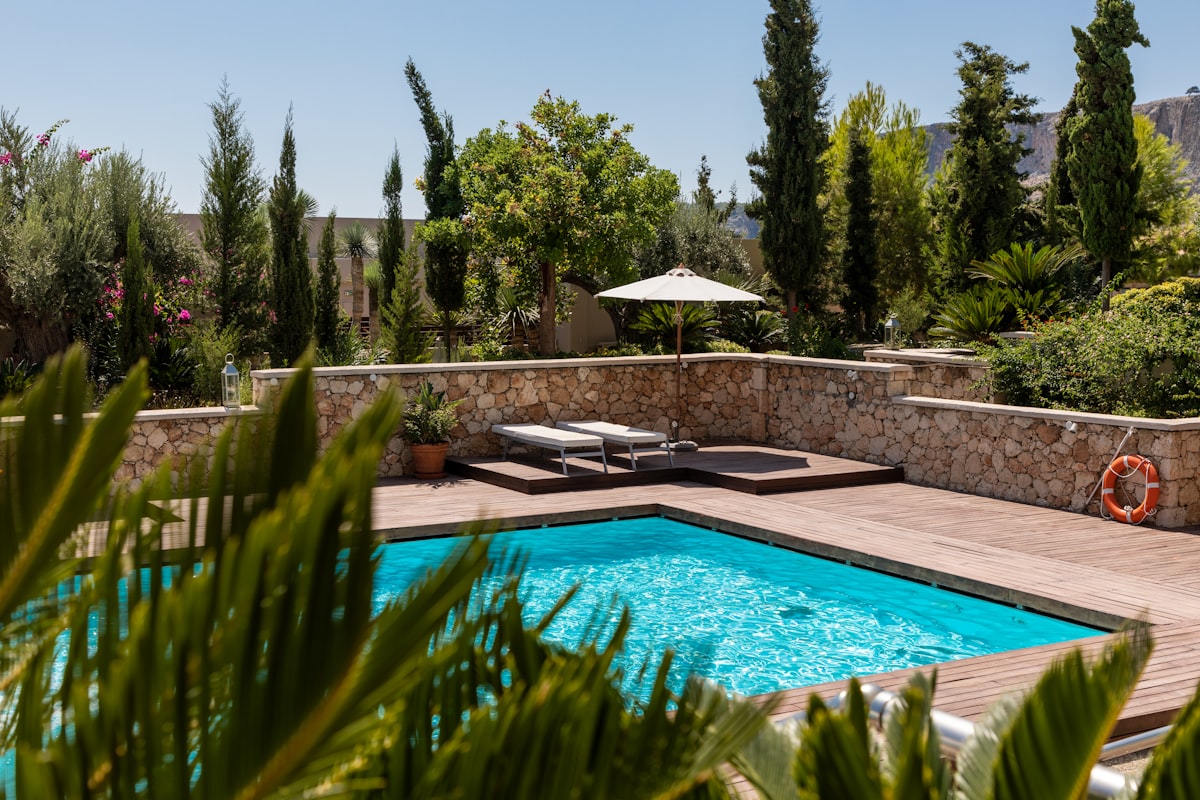
The pool deck and coping serve both aesthetic and functional purposes. Coping — the cap at the top of the pool wall — protects the pool shell from water intrusion at the bond beam, provides a finished edge, and defines the visual boundary of the pool. Cantilevered concrete coping extends over the pool edge, creating a clean modern look while directing splash-out water away from the pool shell. Natural stone coping — travertine, limestone, bluestone, flagstone — provides a premium appearance at $30 to $80 per linear foot installed. Precast concrete coping in bullnose and cantilevered profiles offers a budget-friendly alternative at $15 to $30 per linear foot. Brick coping, popular in traditional designs, runs $20 to $40 per linear foot. All coping installations must include an expansion joint between the coping and the pool deck to accommodate differential movement — typically a 1/2-inch foam joint sealed with flexible polyurethane sealant.
Deck material selection involves trade-offs between aesthetics, heat absorption, slip resistance, and maintenance. Concrete — poured, stamped, or exposed aggregate — remains the most common pool deck surface. Poured concrete with a broom finish provides good slip resistance at the lowest cost ($6 to $12 per square foot), while stamped and colored concrete ($12 to $20 per square foot) mimics stone or brick with lower material costs. Travertine and limestone pavers have become increasingly popular for pool decks because their light color reflects rather than absorbs solar radiation, keeping the surface comfortable for bare feet in direct sun — an important consideration in hot climates. Paver costs run $15 to $30 per square foot installed. The paver base — typically 4 to 6 inches of compacted crushed stone over geotextile fabric — is critical for preventing settlement and maintaining a level surface, and should be included in any paver installation specification. Wood and composite decking around pools requires special consideration: the chemicals in treated wood can react with pool water chemistry, and composite materials can become extremely hot in direct sun — surface temperatures of 150°F or more are common on dark composite decking in summer sun, creating a burn hazard for bare feet.
Need personalized advice?
Essential Tips for Pool and Spa Projects
- Size your equipment for your specific pool. An oversized pump wastes energy and can damage filters by forcing water through them at excessive flow rates. An undersized pump cannot achieve proper turnover — the time required to circulate the entire pool volume through the filter, typically 6 to 8 hours for residential pools. Pump sizing should be calculated based on pool volume, plumbing diameter, and total dynamic head (the resistance to flow through the plumbing system), not selected from a standard spec sheet.
- Plan for access to equipment. Pool pumps, filters, heaters, and automation panels require regular maintenance and eventual replacement. Locating equipment where it is easily accessible — not crammed into a corner behind landscaping that will grow to block access — saves service cost and frustration for the life of the pool.
- Run larger plumbing than the minimum required. Pool plumbing is typically 1.5-inch or 2-inch Schedule 40 PVC. The larger diameter reduces flow resistance (head loss), allowing the pump to move the same volume of water using less energy. The incremental material cost of 2-inch versus 1.5-inch plumbing is modest — typically a few hundred dollars — and the energy savings compound over the decades-long life of the plumbing system.
- Budget for decking and landscaping from the start. The pool itself attracts the attention during planning, but the hardscape and landscape that surround it determine how the pool integrates with the property and how the space is used. Decking costs often equal or exceed the pool structure cost for premium materials and complex designs. Including these costs in the initial budget prevents the disappointing result of a beautiful pool surrounded by unfinished dirt and temporary fencing.
How much does an in-ground pool cost?
Next Steps Toward Your Project
With a solid foundation in Pool Construction Timeline and the broader considerations of pool and spa building projects, you are prepared to move forward with confidence. The most productive next step is a site evaluation by a qualified contractor — ideally, two or three — who can assess your specific property conditions, discuss your goals for how the pool will be used, and provide preliminary recommendations and cost ranges. These consultations typically take 1 to 2 hours and, because pool construction is so site-specific, the information you gain is far more valuable than any amount of general research.
As you evaluate contractors, look beyond the renderings and the sales presentation. Ask to visit completed projects — ideally projects that are at least 3 to 5 years old, so you can see how the pool and surrounding hardscape have held up over multiple seasons. Pay attention to details during these visits: Are the expansion joints between coping and deck intact? Is the deck surface level and free of settlement? Does the equipment pad show signs of organized, professional installation — straight plumbing runs, properly supported pipes, weatherproof electrical connections, and clear labeling of valves and equipment? These details reveal the standard of workmanship you can expect. Ask the homeowner about their experience — not just the finished product, but how the construction process went, how the contractor handled issues that arose, and whether the pool has required any significant repairs since completion. This information, combined with the technical knowledge from this guide, positions you to make an informed, confident decision about your pool and spa building project.
Ready to get started?
Related: Services · Cost calculator · City guides
Ready to apply this to your pool & spa builders plan?
Ready for numbers on your property?
Request a free written estimate for your pool & spa builders plan — no obligation.
Get Free EstimateWatch: design context
Stock design footage related to pool construction timeline — planning inspiration, not a filmed local job.
Pool Construction Timeline — Pool & Spa Builders planning tips
Stock design footage for home-improvement planning inspiration. Not a filmed client project.
Video transcript / description
Visual transcript for “Pool Construction Timeline — Pool & Spa Builders planning tips”. This is silent stock design footage used for planning inspiration only. Scenes typically show modern residential exteriors, interiors, materials, or outdoor living spaces. There is no spoken narration, no on-screen dialogue, and no claim that this is a completed client project in any city. Use this clip to explore design ideas — materials, light, proportion, and outdoor/indoor flow — before requesting a written estimate.
Next step
Ready to plan your Pool & Spa Builders project?
Free estimate. Clear scope. No obligation.